The story of the kasu mala — coin necklaces of South India
Why Lakshmi-coin necklaces have endured for a thousand years across temples, dancers and brides.
Coins as devotion
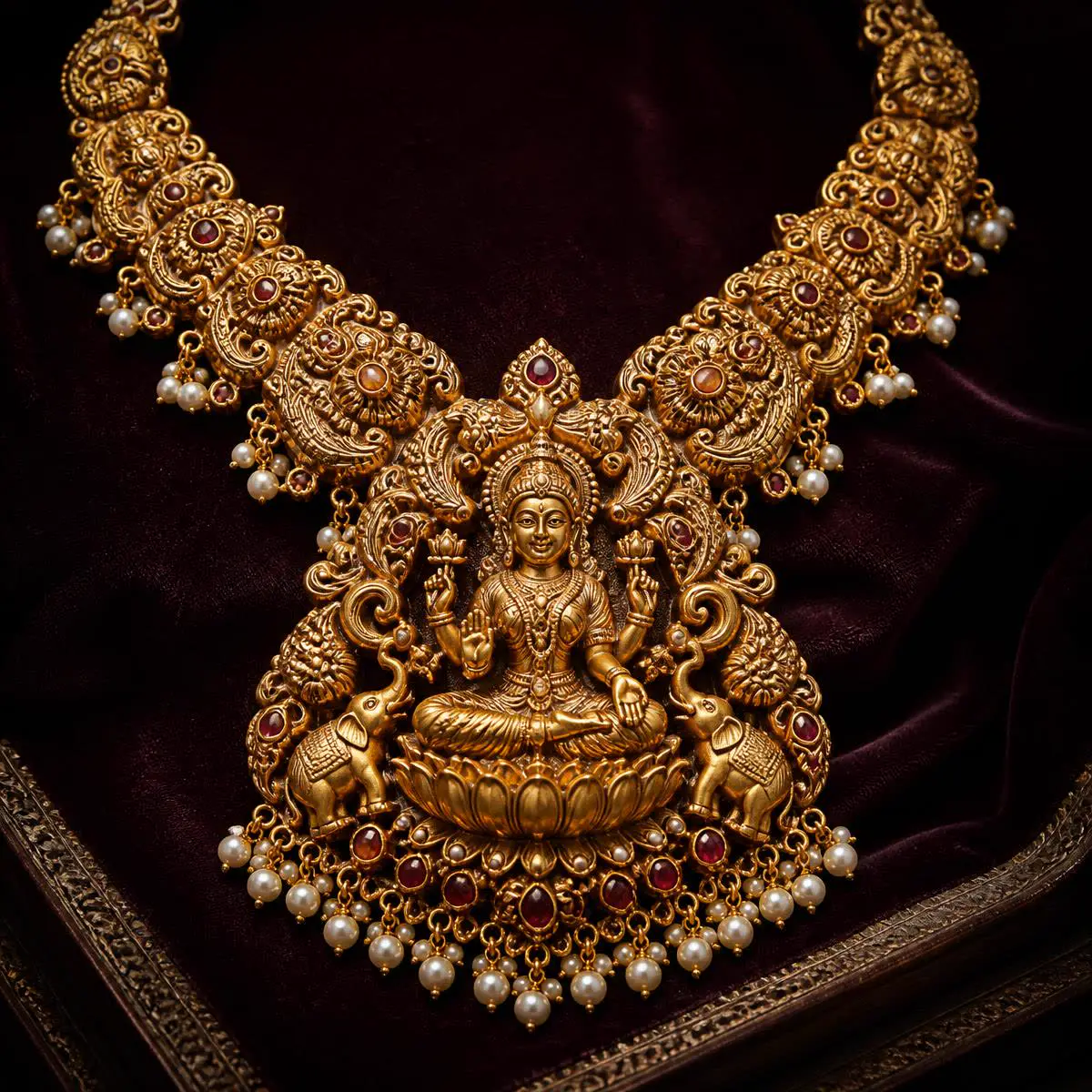
Kasu means 'coin' in Tamil. The kasu mala — strands of gold coins stamped with the goddess Lakshmi — originated as temple offerings and royal regalia in the Vijayanagara era. Each coin carries the goddess of prosperity; a strand of them is a wearable blessing rather than a display of wealth.
The earliest kasu malas were literal currency. Gold coins gifted to a temple, or issued by a ruling house, were pierced and strung so they could adorn the deity during festival processions. Because coinage of that period already carried divine iconography — Lakshmi seated on a lotus, flanked by lamps — the leap from money to ornament was a short one. What began as an act of offering became a distinct jewellery form with its own grammar of proportion, spacing and sound.
From the sanctum to the bride
When temple jewellery moved from the deity to bharatanatyam dancers and eventually to brides, the kasu mala came with it. Dancers valued it for the way the coins catch light and move with the body; families valued it because it could be added to, coin by coin, across generations.
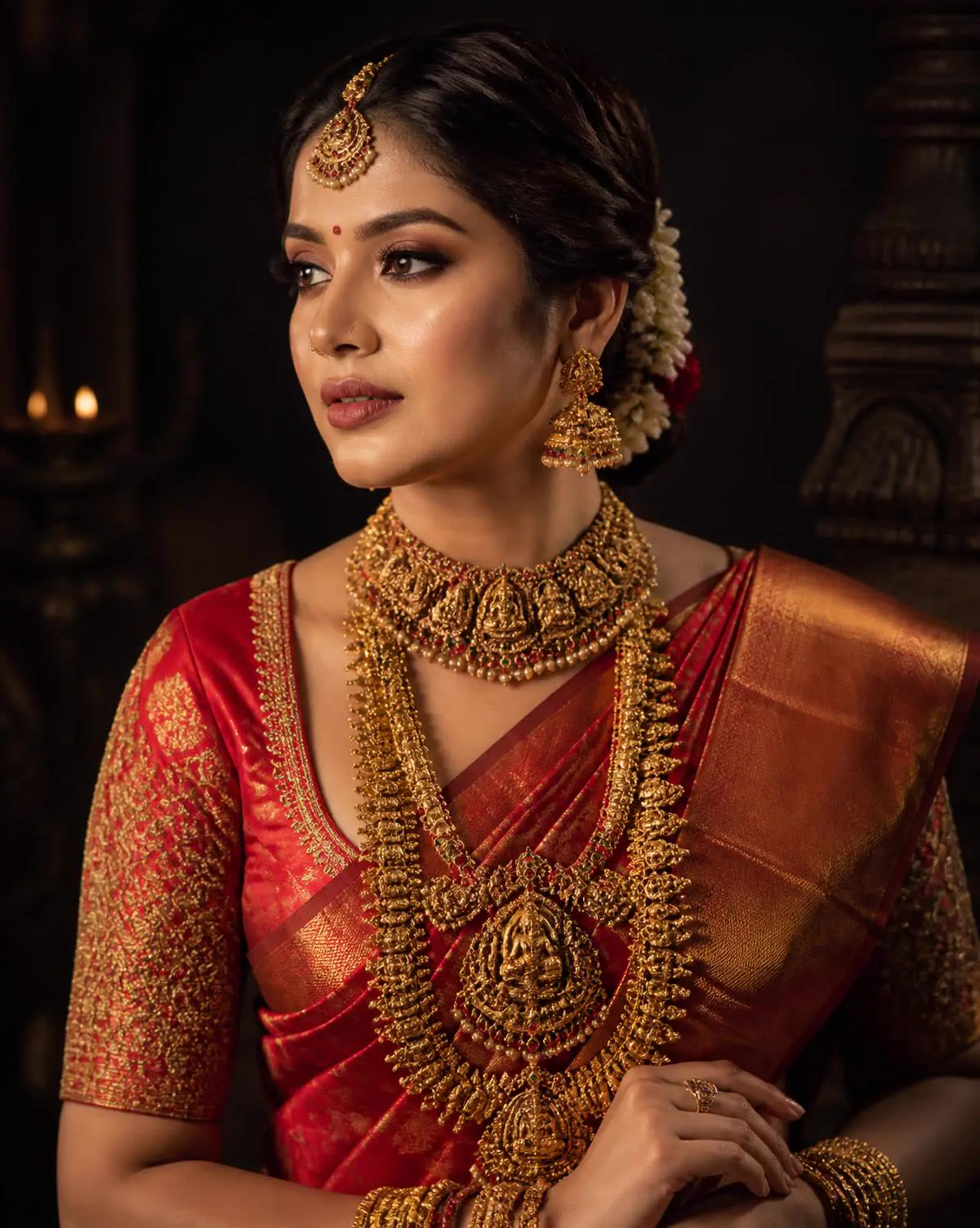
Today it remains essential to a complete South Indian bridal layering. The conventional composition places a fitted addigai or choker at the throat, the kasu mala at the collarbone or mid-chest, and a long Lakshmi haram or manga malai below it. Worn together the three lengths read as one ornament, which is why weight balance between them matters more than the weight of any single piece.
Regional preferences differ. Tamil Nadu families lean towards densely packed coins with minimal spacing; Andhra and Telangana commissions often alternate coins with ruby or emerald beads; Kerala work favours plain polished coins with no stone at all, letting the gold do the speaking.
How a kasu mala is made
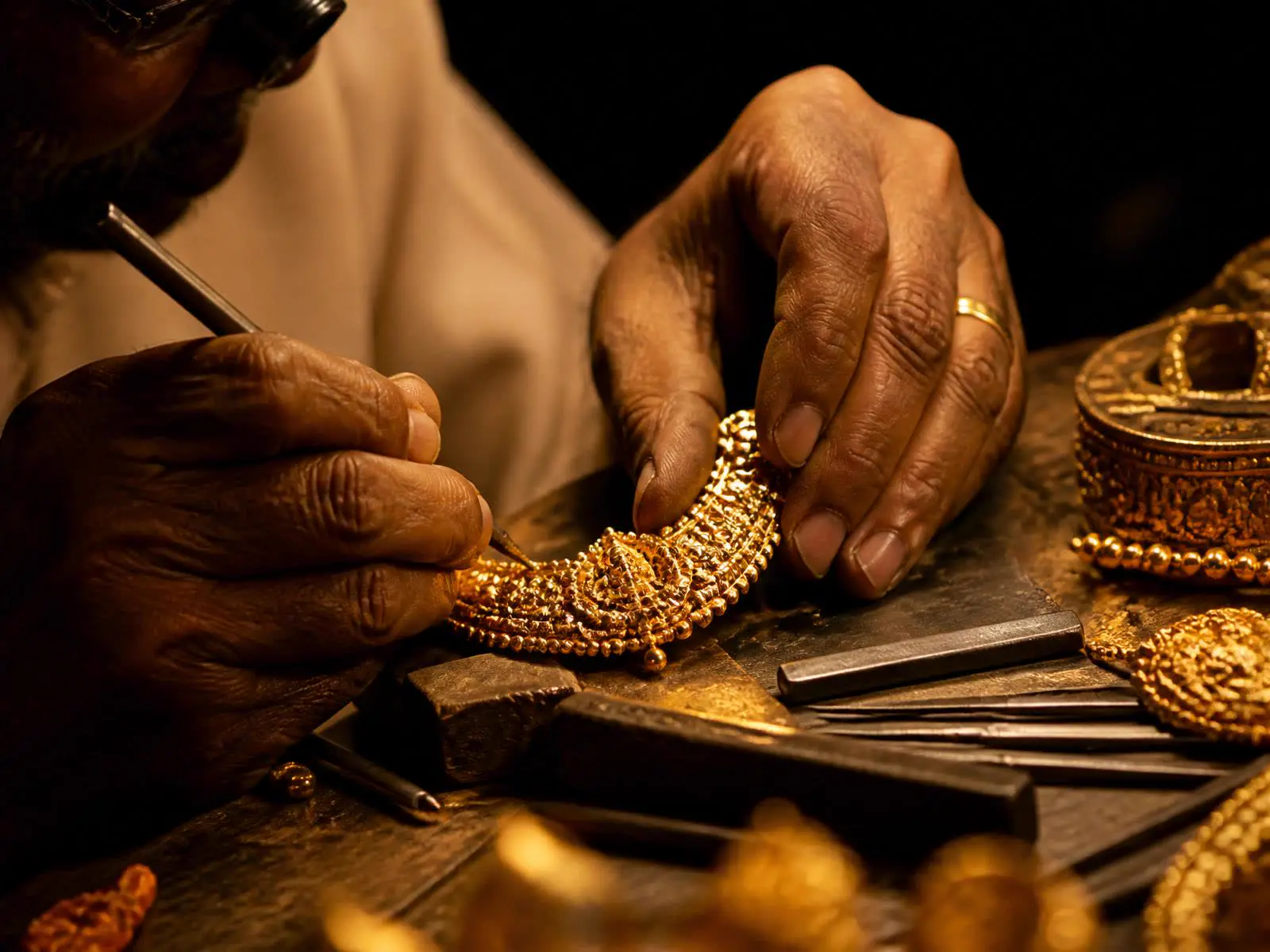
Each coin is either die-struck from a 22K gold sheet or hand-chased by a karigar using a punch and hammer. Hand-chased coins are slightly irregular in relief and are prized for exactly that reason — the small variations prove a human hand set each impression.
The coins are then edged, sometimes with a twisted wire border, drilled and fitted with individually soldered jump rings. Stringing is done on a braided gold or silk core depending on the weight. A well-made mala hangs in a smooth arc with no coin overlapping awkwardly and no visible kink at the clasp.
Finishing is the final decision. A bright polish suits contemporary wear; an antique or oxidised finish sinks into the recesses of the coin relief and makes the Lakshmi figure read clearly from a distance, which is why bridal and temple commissions almost always choose it.
Weights, lengths and how to choose
A short single-row kasu mala of 20 to 35 grams sits at the collarbone and works for festive and daily-formal wear. A mid-length strand of 40 to 70 grams reaches mid-chest and is the most versatile bridal-adjacent choice. Full kasu harams begin near 90 grams and can exceed 200 grams in multi-row bridal sets.
Coin counts are traditionally odd — 21, 25, 27 and 51 are all common — because odd numbers are considered auspicious. For a bride of shorter stature, prefer fewer, slightly larger coins over many small ones: the ornament reads bolder without adding length.
If the mala is intended as an heirloom that will be extended later, ask the workshop to leave the design open-ended so matching coins can be added on both sides of the centre without redoing the stringing.
Reading a kasu mala for authenticity
Look at the coin face first. Authentic kasu malas use hand-struck Lakshmi coins with crisp detail and a slight irregularity that machine-stamped, hollow-backed imitations lack. Turn the strand over — the reverse of each coin should be solid and finished, not thin and dished.
Then check the engineering. Jump rings must be soldered closed, not merely pinched shut, and the clasp should be a screw fitting rather than a spring ring, because a spring ring will fail under this weight. Finally, confirm the BIS 916 hallmark and the six-digit HUID, and verify the HUID in the BIS Care app against the piece's stated weight.
Caring for coin jewellery
Coins rub against one another with every movement, so store a kasu mala flat in a soft pouch rather than hanging it, and never stack it under heavier harams. Clean with mild soap in warm water and a soft brush, working along the coin edges where residue collects, then pat dry immediately.
Have the stringing and clasp inspected once a year. Restringing a mala before a core wears through costs a fraction of recovering lost coins after one breaks in wear.
Kasu malas at Ambaa Gold
Our kasu malas are hand-crafted at our Mumbai atelier by karigars trained in the Nagercoil and Vadasery temple-jewellery traditions, in 22K (916) BIS hallmarked gold with antique or bright finishes. We produce short strands, mid-length malas and full bridal harams, in plain gold or with ruby, emerald and uncut stone accents.
We also supply kasu malas at wholesale to retailers across South India and the Gulf, including private-label runs marked with the retailer's own hallmark. To commission a piece or request the wholesale catalogue, speak with us on +91 98696 09368.
Frequently asked questions
- What is a kasu mala?
- A kasu mala is a South Indian gold necklace strung with coin-shaped units, each traditionally stamped with the goddess Lakshmi. 'Kasu' means coin in Tamil, and the necklace is worn as a symbol of blessed, accumulated wealth.
- How many coins does a traditional kasu mala have?
- Traditional strands use an odd count considered auspicious — commonly 21, 25, 27 or 51 coins. Bridal harams can carry over a hundred coins across multiple rows.
- How much does a 22K kasu mala weigh?
- A short single-row kasu mala usually weighs 20–35 grams, a mid-length strand 40–70 grams, and a full bridal kasu haram 90–200 grams in 22K (916) gold.
- How do I verify an authentic kasu mala?
- Check for a BIS 916 hallmark and six-digit HUID, hand-struck coin faces with crisp Lakshmi detail, individually soldered jump rings, and a screw-fitting clasp rated for the weight.